

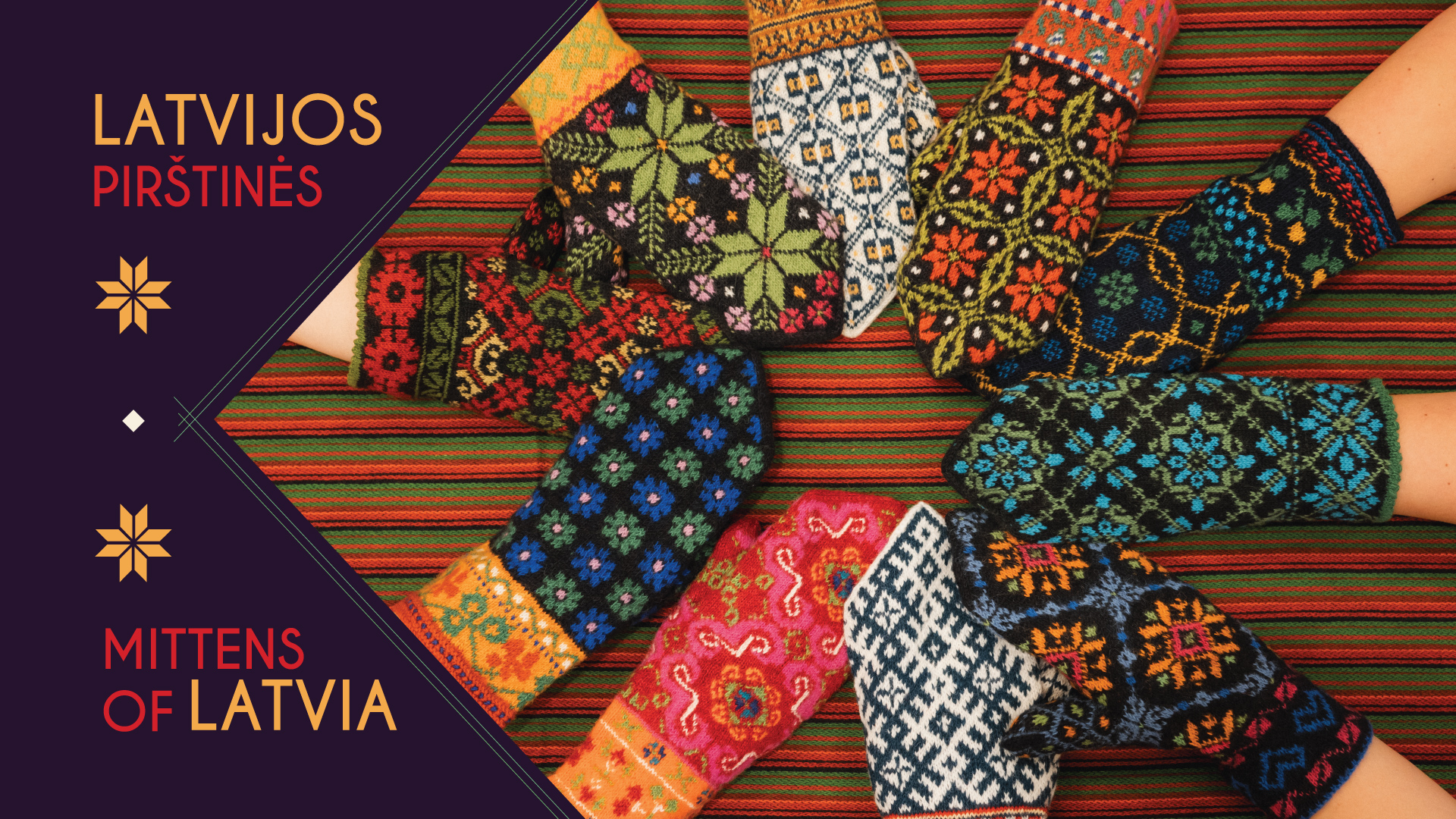
MITTENS OF LATVIA
Very much like folksongs—which through the centuries have expressed for Latvians their wisdom of life, their work ethic, and their view of the world—mittens with their ornamental symbols, rhythmic execution, and colourful designs have been the bearers from generation to generation of Latvian taste, handicraft skill, and traditions. As a material object a mitten wears out, unravels and disappears.
Today, hundreds of mittens, which have been collected and saved in museum archives, bear witness to ancient knitting traditions. Most of these mittens were knitted for festive occasions or to be given away as gifts and were stored from generation to generation in dowry chests. Mittens worn every day and for work by our ancestors usually wore out and did not survive. In museums for each of the mittens, the archival inventory number and the civil parish in which it was found are indicated.
Latvia is famous for the fact that the oldest mittens have been found here by archaeologists. They are estimated to be approximately ten centuries old. The tradition of knitting mittens stems from the cold weather of Northern Europe; although it is worth mentioning that centuries ago mittens played a decorative role as well. By fastening them behind the waistband, they were worn in summer as a bijouterie and adornment. For several centuries they were the main form of gift and endowed with magical significance.
Mittens were a very important part of several Latvian traditions. Probably the most popular role played by mittens is at a wedding, as we have saying “To fit together like a hand and a mitten”. Tradition says that before an unmarried girl entered marriage, she had to fill a dowry chest. Mittens were an important part of the chest. The most lavish chests contained several hundred pairs of handmade mittens. They were given as gifts. Early tradition calls this giving process dedicating or devoting. The mittens were given to the mother-in-law, father-in-law, brother-in-law, and other people involved in organising the wedding. They were dedicated to cows, sheep, and horses and left in places where the newly-weds were going to live.
The most exiting fact is that every mitten had to be knitted in a different design using different patterns; otherwise, the maids were laughed at.
Ethnographically, Latvia consists of five large regions: Vidzeme, Latgale, Sēlija, Zemgale, and Kurzeme. Each of the regions had its own mitten-knitting traditions, colour choices and the patterns used in mittens.
The most ancient are narrow borders or cuffs created by following a knit and purl ribbed pattern. Sometimes rows of pīnīte, a ‘braided’ pattern, or skujiņa, meaning a ‘fir needle’ pattern, are inserted. Such a mitten cuff is encountered in all regions. The mitten cuffs can be very rich in colours and patterns, especially in Kurzeme. They are splendid accents and very nicely supplement the main pattern. In Latgale, there is a striking variation in the technical execution of cuffs. Contrary to the knitting customs in other regions, one often finds in Latgale the so-called lentveida, meaning ‘ribbon-like’ cuffs, that is, cuffs that are knitted separately as ribbons.
The use of natural shades of sheep’s wool is characteristic for mittens of the Vidzeme region. The most widely used colour combinations in Vidzeme are white with shades of brown, blue or red. Mitten cuffs very often are decorated with pīnīte or a ‘Latvian braid’ and skujiņa, or ‘fir needle’ pattern. More often than in other regions a multicoloured fringe finishes the edge of the mitten.
Unique knitted mittens are found in Zemgale with brightly coloured bands on a white background. Especially remarkable are mittens whose patterning is organized in bands for the full length of the mittens and whose knitted patterns are supplemented by embroidery. The embroidery is a stem and a chain stitch, which outlines the individual pattern contours, thus accenting, for example, the square sun, the jumis ‘roof’, the moon, or the zalktis ‘grass snake’ patterns.
For the Latgale mittens, the design of upper mitten is organized not only in an overall pattern but also with bands. A great variety of patterns and colours can be seen in these mittens. Rhombus-shaped elements often form the basis of the overall pattern, within which various different crosses, suns, or stars have been scattered. The pattern consists of several designs created in so masterly a fashion that it is difficult to differentiate what constitutes the patterns and what is background.
Uncoloured sheep’s wool was widely employed in Sēlija. Many of the mittens were knitted on a white background with various shades of brown or indigo blue patterns. A characteristic design for the overall pattern was a geometric knit executed on the bias with simple supplementary patterns.
In Kurzeme, the combinations of patterns stand out because of their large and magnificent designs, which alternate with rich supplementary patterns. Characteristically in Kurzeme, the centres of the squares executed on a bias are enriched by the well-known symbols of the cross, the rosette, or a square sun.
Nowadays Latvian mittens, so diverse in their colours and patterns, are still an essential part of our winter clothing. The originality, tradition, warmth and sense of Latvia that is knitted into a mitten will be always worth a compliment.
NATIONAL COSTUME
Latvian national costume has played and still plays an important symbolic role in the preservation of national values and cultural heritage and in the creation of a feeling of unity of the people. There are five regions in Latvia with their own specific traditions in dialect and costume. These regions are Kurzeme in the west, Zemgale in the mid-south, Sēlija in the south-east, Latgale in the east and Vidzeme in the central and northern parts of Latvia.
There are two popular historic periods of specific traditions that characterise Latvian national costume: costume of the 7th-13th century that is often referred to as ‘ancient dress’ or ‘archaeologic costume’ and clothing worn in the 19th century and referred to as ‘ethnic dress’ or ‘ethnographic costume’. Today national costume is worn on festive occasions, weddings or during performances.
The National Costume Centre SENĀ KLĒTS (‘Old Granary’) was established in 1991 to foster the appreciation of the rich cultural history of our Latvian heritage and to conduct scholarly research into its national folk costumes and ethnographic mittens. SENĀ KLĒTS is the repository and storehouse of the Latvian ethnographic art, where every piece is a distinguished item handmade with love and care by Latvian craftsmen. Significant work has been invested in the reconstruction and fashioning of replicas of authentic examples of Latvian folk costumes, thus creating a collection of more than 70 different folk costumes representing the various regions of Latvia. In our collection we posses more than 400 pairs of beautiful and colourful Latvian mittens. The book “Mittens of Latvia” was published in seven languages and reprinted several times, as many knitters consider it as a book for inspiration.


 Daržų st. 10, LT-91246, Klaipėda


