

Flamenco. Spain
- Home
- Festivals
- Lauksnos
- 2026
- Traditions
- Flamenco. Spain
Flamenco
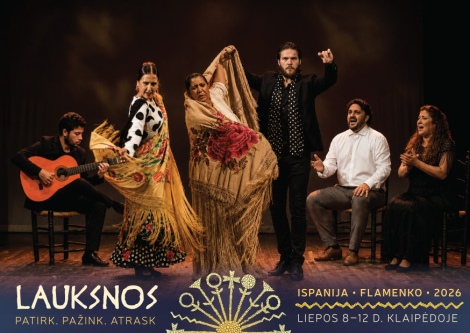
Flamenco is an artistic expression fusing song (cante), dance (baile) and musicianship (toque). Andalusia in southern Spain is the heartland of Flamenco, although it also has roots in regions such as Murcia and Extremadura. Cante is the vocal expression of flamenco, sung by men and women, preferably seated, with no backing singers. The gamut of feelings and states of mind – grief, joy, tragedy, rejoicing and fear – can be expressed through sincere, expressive lyrics characterized by brevity and simplicity. Flamenco baile is a dance of passion, courtship, expressing a wide range of situations ranging from sadness to joy. The technique is complex, differing depending on whether the performer is male (heavier use of the feet) or female (gentler, more sensual movements). Toque or the art of guitar playing has long surpassed its original role as accompaniment. Other instruments, including castanets, hand-clapping and foot-stamping are also employed. Flamenco is performed during religious festivals, rituals, church ceremonies and at private celebrations. It is the badge of identity of numerous communities and groups, in particular the Gitano (Roma) ethnic community, which has played an essential role in its development. Transmission occurs through dynasties, families, social groups and Flamenco clubs, all of which play a key role in its preservation and dissemination.
The Peña Cultural Flamenca Torres Macarena
The Peña Cultural Flamenca Torres Macarena was founded in 1974 by a group of friends united by their love of flamenco. Gradually, leading artists began to join them, and the club became an essential hub for flamenco within Seville’s cultural life.
As set out in its statutes, the club’s fundamental aim is to preserve, promote, protect and foster the art of flamenco as an authentic culture.
Over its more than fifty years of existence, Torres Macarena has hosted performances by the finest flamenco singers and dancers of the second half of the 20th century and the first quarter of the 21st century. It is a place where flamenco is respected and listened to with reverence. For this reason, winning over the demanding audience of this club – comprising a knowledgeable public – is an important goal for all artists, especially young ones.
True to its mission of disseminating and promoting the art of flamenco, declared Intangible Cultural Heritage of Humanity by UNESCO in 2010, Torres Macarena has brought together an excellent group of artists, linked to the club, who combine youth and maturity, freshness and experience.
GUITAR PLAYER: DAVID CARO
A young guitarist from Almería, who completed his training as a solo and accompaniment guitarist at the Conservatorio Superior de Córdoba. At the same time, he took classes in jazz harmony. He began his professional career at the age of 17, accompanying the flamenco singer Juan Pinilla.
SINGER: GABRIEL DE LA TOMASA
Born in Seville, hailing from the Macarena neighbourhood, Gabriel comes from a distinguished family of artists. He has forged his own career as a singer for dance, although we have also been able to enjoy him at our club in his role as a soloist. Following his time with the Ballet Flamenco de Andalucía, he has been living in Madrid for several years and is a member, as a singer, of the cast of the Spanish National Ballet.
SINGER: CRISTINA TOVAR
She began her training at the Seville Professional Dance Conservatory and, upon completing her career as a dancer, began studying flamenco singing at the Cristina Heeren Foundation. After completing her training, she worked as an assistant teacher at the Foundation for seven years. She has sung at numerous peñas and festivals, has taken part in the Flamenco Viene del Sur series, and has toured several continents with various companies.
DANCER: LAURA SANTAMARÍA
She was born into a family of artists and trained from a very young age with leading figures. She holds a degree in Spanish Dance. Laura Santamaría has set up her own company, with which she tours Spain and abroad. She is also noted for her work as a teacher. Her style is characterised by her mastery of the techniques of the bata de cola and castanets, so typical of the Sevillian school. Her roots are mainly traditional, yet she does not overlook the innovation of her generation.
DANCER: MIGUEL EL RUBIO
He was born in Seville into a family with a long tradition of flamenco. From a young age, he devoted himself entirely to flamenco dance, making his debut at the age of five. As well as teaching and performing at Spain’s most renowned tablaos, Miguel has performed at numerous festivals and theatres around the world. His dancing stands out for its elegance and restraint, coupled with a superb command of rhythm and handclapping.
DANCER: CARMEN LEDESMA
With half a century of artistry under her heels, Carmen Ledesma is one of the grand dames of Sevillian dance who is still performing today. She has a highly personal style, with a vintage flavour, infused with a great deal of passion and freedom. In contrast to the growing prominence of technique in contemporary flamenco, Carmen is a master of the art of improvisation on stage, of knowing how to hold her ground and say it all with a single glance. She has been a prominent figure at numerous flamenco festivals. For decades, she has also combined her artistic work with teaching at schools. She also runs workshops and masterclasses in numerous countries.

 Daržų st. 10, LT-91246, Klaipėda


