

The hammer dulcimer playing tradition in Ignalina and Švenčionys regions
- Home
- Festivals
- Lauksnos
- 2026
- Traditions
- The hammer dulcimer playing tradition in Ignalina and Švenčionys regions
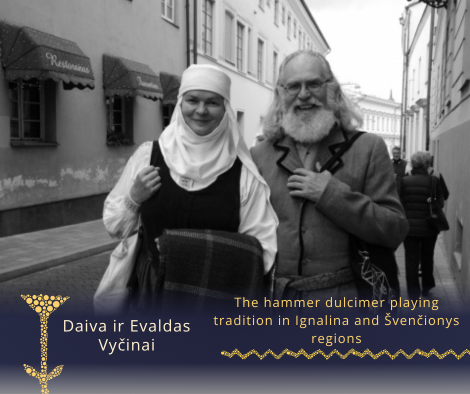
The hammer dulcimer playing tradition in Ignalina and Švenčionys regions
The hammer dulcimer, or cimbolai, has been mentioned in Lithuanian written sources since the second half of the 16th century. Sources indicate that the hammer dulcimer was introduced to Lithuania in the 14th century by musicians who were travelling throughout Europe. Craftsmen and musicians made their own unique instruments. The first music played on them was recorded during the interwar period.
The hammer dulcimer became particularly popular in Ignalina and Švenčionys regions, where it was played at gatherings and festivals. Now they can be heard at public events – traditional culture competitions, folklore concerts, and get-togethers. The tradition is passed down from one musician to another and to family members, who learn the hammer dulcimer repertoire and playing techniques by ear. Every player has their own unique playing style.
The hammer dulcimer is placed on the lap or on a table, or suspended from the neck by straps, with the lower strings facing the player. Sound is produced by striking the strings with two wooden hammers, which are sometimes wrapped in soft leather or felt. In the regions of Ignalina and Švenčionys, it is traditional to play the melodies of polkas, waltzes, Suktinis, and other favourite folk dances; players also accompany songs, especially those sung at Easter. The hammer dulcimer is played both as a solo instrument and in an ensemble. There are several ways to play music: by playing a melody, accompanying another instrument, or playing a backing part.
Since 2007, traditional hammer dulcimer music courses have been held annually in Palūšė, Ignalina district, organised by specialists from the Administration of Aukštaitija National Park and the Lithuanian National Culture Centre. The aim is not only to introduce musicians of all ages to the instrument, but also to reveal the specifics of playing it, as well as the techniques for playing solo and in ensembles – which is why this tradition is valued and recognised as embodying the uniqueness of the local musical culture.
Daiva and Evaldas Vyčinai
Daiva and Evaldas are renowned Lithuanian ethnomusicologists, folklore performers, and promoters of traditional culture. For this work, they were awarded the most prestigious prize in the field of ethnic culture – the Jonas Basanavičius State Prize – back in 2002. Both Evaldas and Daiva became involved in the folklore movement while still in school; they later became actively involved in regional studies, recording numerous songs, instrumental music, etc. from rural people in various parts of Lithuania and in ethnic Lithuanian territories during their expeditions. Since 1989, both have been teaching in the Department of Ethnomusicology at the Lithuanian Academy of Music and Theatre (Daiva has been the head of this department since 2001); each one is pursuing their own line of research. Daiva Vyčinienė is a renowned researcher and performer of sutartinės, but her research also covers other genres of sung folklore. Evaldas Vyčinas is rightly called the “father of folklore” and the pioneer of post-folklore in Lithuania; he is also renowned as a multi-instrumentalist – he plays nearly all traditional musical instruments and has reconstructed many old musical instruments. Daiva and Evaldas sing together at various events, where they sometimes showcase old musical instruments; they also enjoy playing with other traditional musicians.
Songs recorded by folklore collectors Antanas and Jonas Juškos and Liudvikas Rėza hold a special place in the repertoire of the Daiva and Evaldas Vyčinai duo. They are sung to the accompaniment
of traditional kanklės and are a form of meditation that transports the listener to the idyllic world of the 19th century. Today, few people know that Evaldas Vyčinas, known as the “father of folklore,” was the first to popularise these songs, accompanying himself on the hammer dulcimer and the kanklės.

 Daržų st. 10, LT-91246, Klaipėda


